


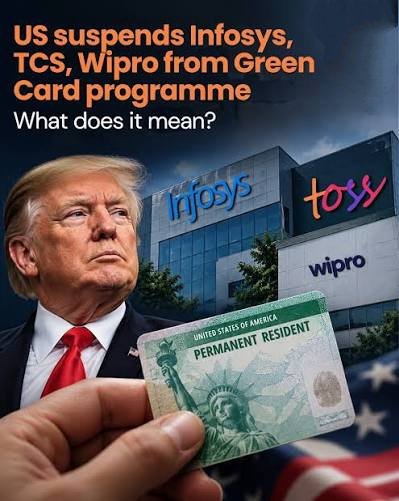
The American Dream has long attracted thousands of Indian students and technology professionals seeking better career opportunities, higher salaries and permanent residency in the United States. However, recent reports about the suspension of eight major technology companies from the US Permanent Labour Certification programme, commonly known as PERM, have raised concerns about the future of employer-sponsored immigration for Indian professionals.
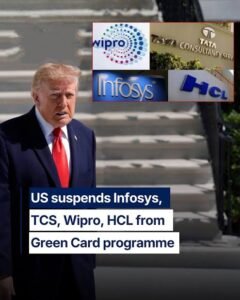
According to the reports, the companies affected include five major Indian IT service providers — Tata Consultancy Services (TCS), Infosys, Wipro, HCL Technologies and Cognizant — alongside Microsoft, Adobe and Capgemini. If confirmed, the development could create uncertainty for employees hoping to obtain US permanent residency through their employers.
What Is PERM and Why Does It Matter?
PERM, short for Program Electronic Review Management, is a labour certification process administered by the US Department of Labor. It is an important step in many employment-based Green Card applications, particularly those filed under the EB-2 and EB-3 categories.
Through this process, employers generally must demonstrate that there are not sufficient qualified, available US workers for the position and that employing a foreign worker will not adversely affect the wages and working conditions of similarly employed US workers.
For Indian professionals working in the technology sector, PERM can be a significant part of the journey towards permanent residency. Delays or restrictions affecting an employer’s ability to initiate or process labour certification applications could therefore complicate long-term immigration plans.
Does This Mean H-1B Visas Have Been Cancelled?
One of the biggest concerns surrounding the reports is whether Indian professionals already working in the United States will lose their legal status.
The important distinction is that PERM and the H-1B visa programme serve different purposes. An H-1B visa allows eligible foreign professionals to work in specialised occupations for a qualifying employer, subject to applicable immigration rules. PERM, meanwhile, is associated with the employment-based Green Card process.
Therefore, a reported suspension from the PERM programme does not, by itself, automatically cancel existing H-1B visas. Workers must continue to meet the requirements of their visa status, and individual circumstances may vary.
India’s Ministry of External Affairs has also been cited in reports clarifying that the development does not automatically invalidate existing H-1B visas. The precise scope and legal implications of the reported suspensions, however, should be assessed against official US government records and statements.
What Could This Mean for Indian Professionals?
India is a major source of skilled technology workers in the United States, and large IT companies play an important role in recruiting and sponsoring international employees.
If the reported restrictions affect these companies’ labour certification activities, employees awaiting Green Cards could face uncertainty, potential delays and changes to their long-term career plans. Indian students aspiring to work in the United States may also become more cautious when evaluating their future options.
However, the reported development should not be interpreted as a complete closure of American opportunities for Indian talent. The United States continues to have multiple employment and immigration pathways, each subject to its own eligibility criteria and regulations.
Is the American Dream Coming to an End?
Not necessarily. The reports highlight how changes in immigration enforcement and employer compliance can influence the plans of international professionals. But a suspension from one programme is not the same as a blanket ban on Indian workers or students.
For now, affected employees should seek guidance from qualified immigration attorneys, consult their employers and monitor official announcements from the US Department of Labor and US Citizenship and Immigration Services.
The American Dream may be becoming more complicated for some Indian professionals, but whether this marks a broader shift in US immigration policy will depend on the verified details, duration and consequences of the reported action.
Sources: ANI , Business Today: Green card public-charge rule,Gulf News,IndianEagle