

Bengaluru Racket Raises Questions for India’s Pharma Credibility
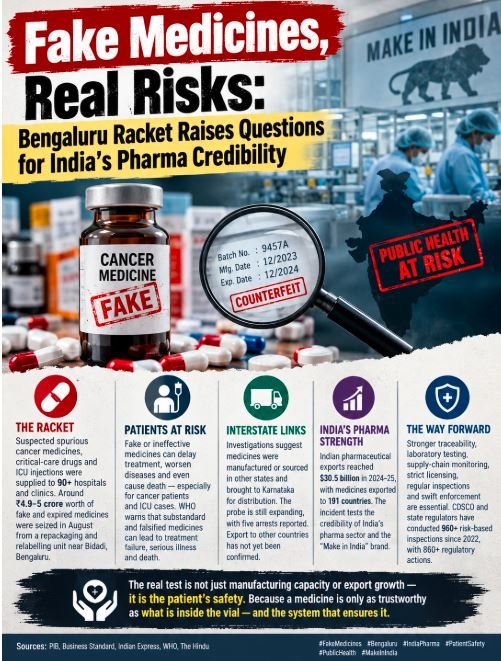
The recent counterfeit-drug racket uncovered in Bengaluru is not simply a story about fake medicines; it raises a much larger question about patient safety, regulatory oversight and the credibility of India’s pharmaceutical supply chain. The investigation has so far revealed suspected spurious cancer medicines, critical-care drugs and ICU injections being supplied to more than 90 hospitals and clinics. In August, authorities seized suspected counterfeit and expired medicines worth around ₹4.9–5 crore from an unlicensed repackaging and relabelling operation near Bidadi. Investigators allege that cheaper or expired medicines were repackaged and given labels resembling those of established pharmaceutical brands.
The most disturbing dimension is the vulnerability of patients. Cancer treatment is already financially and emotionally exhausting for families, with some households spending their savings or selling assets to finance treatment. If a medicine sold as a life-saving cancer drug is falsified or ineffective, the damage is not merely financial. Treatment may be delayed, disease may progress and patients may be exposed to additional risks. The same concern becomes even more critical in ICUs, where medicines and injections can be administered to patients in extremely fragile conditions. The World Health Organization (WHO) notes that substandard and falsified medicines can cause treatment failure, serious illness and death, while also undermining confidence in healthcare systems.
There is also a crucial distinction in the Bengaluru case that should not be overlooked. Current investigations indicate that medicines seized in Bengaluru were allegedly manufactured or sourced in other states and brought into Karnataka for distribution, rather than establishing that a legitimate Bengaluru pharmaceutical manufacturer itself produced all the fake medicines. The investigation is still expanding, with interstate links under examination and five arrests reported.
The allegation that these medicines were exported to other countries requires separate verification. Publicly available reports on the current Bengaluru investigation establish an interstate distribution network, but do not yet conclusively establish that the seized medicines were exported internationally. That distinction matters because India is a major pharmaceutical exporter: pharmaceutical exports reached about $30.5 billion in 2024–25, with Indian medicines exported to 191 countries.
Consequently, the incident has implications beyond one criminal network. It tests the effectiveness of India’s regulatory architecture and the credibility associated with “Make in India.” The government says CDSCO and state regulators have conducted more than 960
risk-based inspections since December 2022, resulting in more than 860 regulatory actions, including licence suspensions and cancellations.
The larger lesson is therefore clear: pharmaceutical credibility cannot depend only on manufacturing capacity and export growth. It depends on traceability, laboratory testing, supply-chain monitoring, strict licensing, inspections and swift criminal enforcement. WHO estimates that at least one in ten medical products in low- and middle-income countries may be substandard or falsified, demonstrating that counterfeit medicines are a global problem.
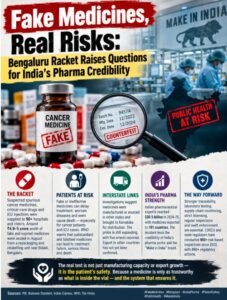
For India, protecting the reputation of its pharmaceutical industry ultimately means protecting the patient first. A medicine may carry a trusted brand, an attractive package and a legitimate-looking label, but its real credibility lies in what is inside the vial—and in whether the regulatory system can guarantee that fact.
Sources: PIB, Business Standard, Indian Express, WHO, The Hindu