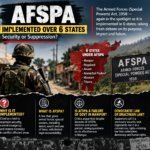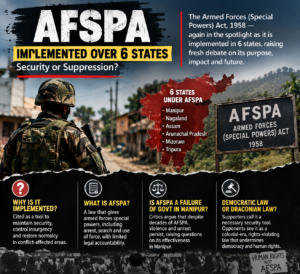


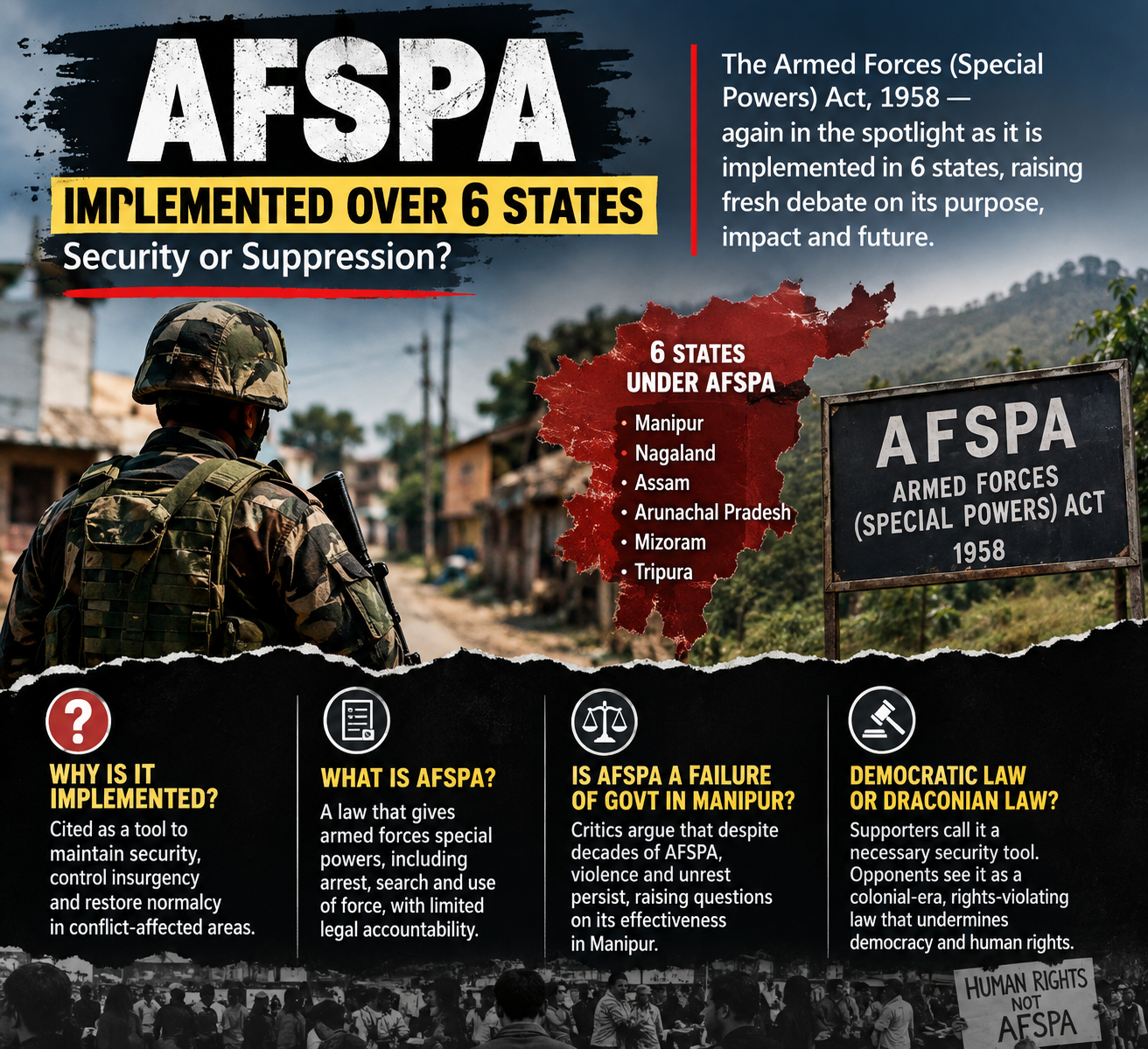
The Armed Forces (Special Powers) Act (AFSPA), 1958 continues to remain one of India’s most debated security laws. At its peak, AFSPA was extended to some parts of six northeastern states—Assam, Manipur, Nagaland, Arunachal Pradesh, Meghalaya and Tripura. However, it has since been progressively withdrawn from several areas.
The Centre has recently extended AFSPA for another six months from October 1, 2026, in disturbed areas of Manipur, Nagaland and Arunachal Pradesh. In Manipur, the extension covers the state except areas under 13 police stations; in Nagaland, nine districts are covered, while specified districts and police-station areas remain under AFSPA in Arunachal Pradesh.
Why is AFSPA implemented?
AFSPA is intended to provide security forces with additional powers in areas where the government considers the situation sufficiently disturbed by insurgency, armed violence or threats to public order. The law allows armed forces personnel, under specified circumstances, to use force, arrest without warrant and conduct searches in a declared “disturbed area.”
The government’s argument is that conventional policing may be inadequate in areas affected by armed insurgent groups, difficult terrain and cross-border militant networks. Official data also indicates that AFSPA has been progressively withdrawn as security conditions improved.
What are the main concerns?
The central controversy lies in the extraordinary powers and accountability mechanisms provided by the Act. Section 4 permits specified use of force, warrantless arrest and search, while Section 6 requires prior Central Government sanction before prosecution or other legal proceedings against personnel acting under the Act. Critics argue that this can create an accountability gap and weaken victims’ access to justice.
The United Nations Special Procedures have also raised concerns over the broad definition of a “disturbed area,” the absence of a statutory time limit and the possibility of prolonged application.
Is AFSPA a failure of government ?
The question is politically and constitutionally contested. AFSPA itself is not proof that the government has failed, because its stated purpose is to assist security operations during exceptional situations. At the same time, Manipur demonstrates the limitations of relying primarily on a security response to a prolonged political and ethnic conflict.
Since the violence that began in May 2023, Manipur has experienced deaths, displacement and continuing insecurity. Amnesty International reported in June 2026 that more than 60,000 people had been displaced and at least 200 killed since the outbreak of violence, while violence and hostage-taking continued.
Thus, the Manipur debate extends beyond AFSPA to questions of political dialogue, civilian protection, policing, accountability and reconciliation.
Democratic law or “draconian” law?
Legally, AFSPA is a law enacted by Parliament, and the Supreme Court upheld its constitutional validity in Naga People’s Movement of Human Rights v. Union of India (1997), while prescribing safeguards including periodic review of disturbed-area declarations.
Calling it “draconian” is therefore a critical characterization, not the legal status of the Act. Human-rights organisations use the term because of its exceptional powers and concerns about accountability, whereas the government maintains that extraordinary security conditions can require extraordinary powers.
The deeper democratic question is consequently not simply whether AFSPA is legal, but whether exceptional military powers remain necessary, proportionate, accountable and subject to meaningful periodic review. Its gradual withdrawal from Meghalaya and Tripura shows that AFSPA can be reduced when security conditions permit; its continuing application in parts of the Northeast keeps the debate over security and civil liberties alive.
Sources
Akhashwani News , Eurasia Review, Indian Kanoon, Ministry Of Home Affairs, The Hindu , Amnesty International