



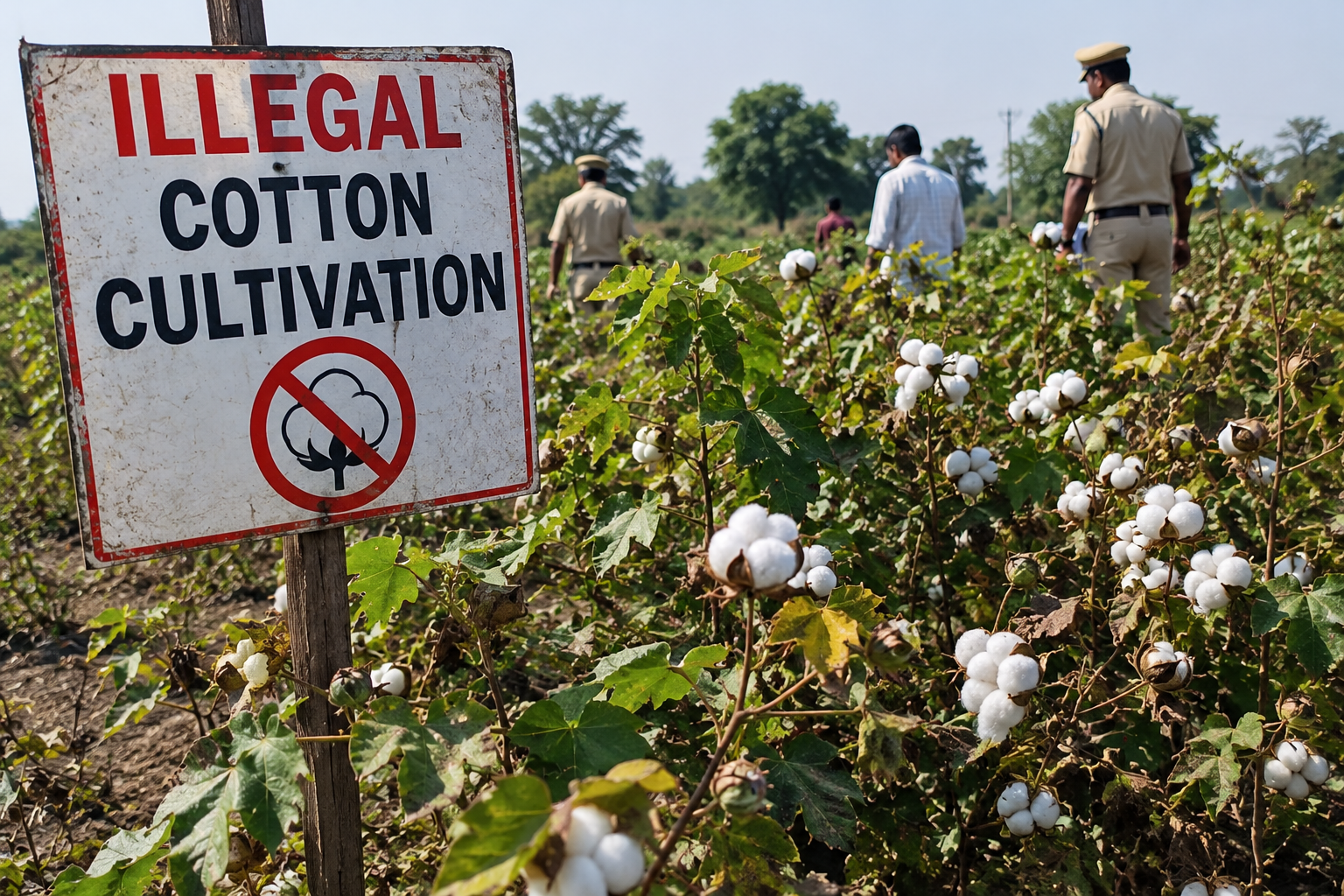
For Indian farmers, every farming season brings new challenges, from rising production costs to labour shortages and unpredictable weather and midst of all of this they wonder how they will feed their family. Now, a new study has raised concerns about the growing cultivation of unauthorised herbicide-tolerant Bt (HTBt) cotton in India. The findings highlight not only a regulatory challenge but also the financial pressures that may be pushing farmers towards unapproved seeds.
According to the study, unauthorised HTBt cotton was cultivated across an estimated 24–30 per cent of India’s total cotton-growing area during the 2025–26 Kharif season. This represents approximately 26.2–29 lakh hectares of land. The study was conducted by the South Asia Biotechnology Centre (SABC), with support from the Federation of Seed Industry of India (FSII) and the National Seed Association of India (NSAI).
The question that arises is:
Why Are Farmers Choosing These Seeds?
One of the major reasons identified by the study is the rising cost of manual weed removal. Farmers often struggle to find enough agricultural labourers, particularly during busy farming periods, while labour costs continue to put pressure on their budgets. Because not all farmers are rich enough to hire labour at expensive rates.
The study estimates that manual weeding can cost ₹12,000–15,000 per acre, compared with approximately ₹750–850 per acre for glyphosate-based weed control. This difference may encourage farmers to consider HTBt cotton, which is designed to tolerate certain herbicides.
For a farmer trying to protect an already limited income, reducing cultivation expenses can seem like a practical decision. However, lower weed-control costs do not automatically guarantee higher yields or greater profits.
Maharashtra Among the Affected States
The study examined 16 districts across Maharashtra, Telangana, Andhra Pradesh and Rajasthan. It estimated that the informal market for unauthorised HTBt cotton seeds was worth approximately ₹820–880 crore.
The findings also indicate significant cultivation in Maharashtra, including districts such as Yavatmal. The spread of these seeds raises questions about how they are reaching farmers despite the absence of approval for their commercial cultivation in India.
What Are the Possible Risks?
HTBt cotton is genetically modified to tolerate certain herbicides. While this characteristic can help farmers manage weeds, the use of unapproved seeds and herbicides without adequate monitoring raises concerns about environmental safety and regulatory compliance.
Repeated use of the same herbicide can also encourage the development of resistant weeds. Farmers who purchase seeds through informal markets may face additional difficulties if the seeds fail to perform as expected.
What Needs to Be Done?
The issue demands more than simply asking farmers to avoid unauthorised seeds. Authorities need to strengthen monitoring of seed markets, improve access to affordable and reliable alternatives, and provide farmers with practical guidance on weed management.
At the same time, the economic difficulties behind this trend cannot be ignored. When farming becomes increasingly expensive, farmers naturally look for ways to reduce their costs.
The central question, therefore, is not just how unauthorised seeds are spreading, but why so many farmers may find them attractive in the first place. Protecting agriculture requires both effective regulation and meaningful support for the people who depend on farming for their livelihoods.
Source: Indian Express